Pages

Ultimate Crown Paladin: Mounted Lockdown Build

Paladin: Oath of the Crown

Enemy Lockdown & Mounted Frontline Defender Build


The Character:

Rosnolir floated far above an expanse of flat, desolate earth that stretched to the horizon: a corona of light burning like a wall of fire. Networks of gorges and canyons scarred the realm, strung together by marble bridges. Hulking pit fiends guarded those crossings in shining silver armor. This wasn't like one of her normal visions. What fresh torment could they want to show her now, ruin her dreams with? 

"Oh, kindred spirit," a silken voice called from the wind, directionless, encompassing, fatherly, "what lies have they been whispering in your ear?"

The vision shifted and Rosnolir stood in the grandest palace she had ever seen: a fey court of darksome beauty, with halls of gold-veined marble. Standing before her was a beautiful man with flowing white hair and perfect features, draped in robes of gold, a simple circlet adorning his head. Rosnolir's legs went weak and she could no longer hold her weight. She found herself kneeling, awestruck, before this resplendent figure.
Nessus, the Ninth Hell

"Who are you?" Rosnolir called to the king.

The figure smiled so warmly, so patiently, Rosnolir payed no mind to the smoke curling up from around where her legs rested on the stone. "I am you, child. Or, I was once much like you ... until they ruined me. They will ruin you, too. That is why I have called you here."

The man spread his arms wide in a gesture of welcome. "I am Asmodeus, Lord of the Hells. This broken land is a remnant of my fall, and I wish to save you from a similar fate."

The Concept: Build, Character, Backgrounds

Unlike the Oathbreaker, the Oath of the Crown Paladin is not ignored, but actively avoided/disliked. I have seen countless posts about how it remains vastly underpowered and how it's 20th level ability falls short of expectation and is inferior to the other paladins'. These posts come from people who do not know how to effectively utilize the tools given to them. I can also infer that people shy away from the Oath of the Crown as they feel it is too "on the nose" for a paladin. The subclass lends itself to being a knight of the round table, sure, but with the right story and race combination, suddenly the Oath of the Crown bears one of the most interesting flavors (Avenged Sevenfold's "Hail to the King" plays somewhere in the background). The Oath of the Crown paladin is not strong because of it's 20th level ability, it is strong because of it's Channel Divinity options paired with its Oath Spells and Paladin Spells. These features combined allow us to make a supreme enemy lockdown build with the added bonus of mounted combat.

The character is a human touched by celestials, marked for greatness, an aasimar, that has fallen from grace after becoming a paladin of Asmodeus, Lord of the Hells. The aasimar, often thought to be gifts to the mortal races by the inhabitants of Mount Celestia, a heavenly plane of the afterlife, are blessed with divine abilities and a link to a celestial guardian. These entities provide guidance to aasimar not through direct command or simple spoken word, but through dreams -- visions, prophecies and feelings. Her dreams were ones of great violence and horror, made to warn her of what was to come.  To a child, being plagued with such visions was more of a curse than a blessing. So, growing into young adulthood, she grew to loathe her gift, and her dreams. She lay awake at night, terrified to close her eyes in fear of what she might see. This provided an opening. A sliver of doubt is enough for the honey-tongued serpent to plant his gilded words upon the ears of a godling.
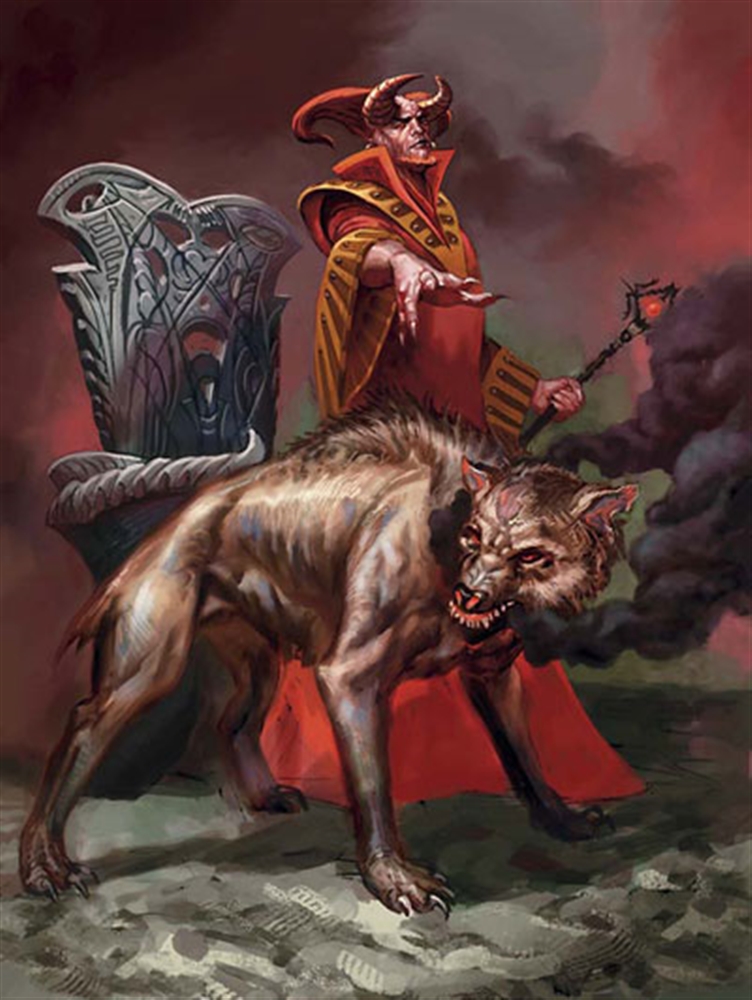
Asmodeus in his true form with a hellhound
Rosnolir received a vision from Asmodeus, once the bravest, toughest, fiercest and most beautiful of angels. He and the other angels of his ilk were created to fight the demons of the abyss while the gods concerned themselves with forging worlds and sentient races. After eons of fighting the demons of the Abyss, Asmodeus and some of his fellows began to change. They grew similar in appearance and methods to the demons they fought. Afraid of his power and the changes he had undergone, the gods put Asmodeus on trial and cast him from Mount Celestia, banishing him to the realm of Baator, what is now known as the Nine Hells, the land which he had spent his entire life clearing of demons. He fell to the deepest level where he sustained serious injuries that have yet to heal all these years later, and from his blood which boiled in rage he birthed forth the first devils. Since then, Asmodeus has waged war with Celestials, murdering them whenever and wherever he could. Though, one thing Asmodeus enjoys more than killing Celestials is corrupting them and bringing them to his side. With a dream that for once did not plague her with maddening scenes of violence and torture, Asmodeus made contact with Rosnolir, planting that fatal seed of doubt, ultimately replacing her internal light with shadow, and causing her celestial guard to abandon her.

As a paladin of The Lord of the Hells, a being of supreme law and tyranny, and a former celestial, Rosnolir's alignment is Lawful Evil. Her character arc may plan on her growing to Lawful Neutral, or even Lawful Good, renewing her celestial status, thought that is up to the player, and not the design of this particular story. Some backgrounds that are appropriate include Faction Agent (with a Charisma skill choice), Mercenary Veteran and Soldier. All of these prioritize Charisma or Strength based abilities, but as always, backgrounds are more up to player preference than optimization. I always like to leave a little bit of the character unwritten so the player can personalize them enough to feel like they are their own.

The Race: Aasimar (Fallen)

As always, I determine story after I've chosen a race, so of course this choice fits the backstory quite well. Let's dive in to why I chose the Aasimar for this build specifically. We like the Aasimar here for several reasons, so let's lay them out. 1) +2 Charisma and +1 Strength. 2) Good healing and damage resistance abilities. 3) Necrotic Shroud (we'll talk more about this later in the post). The stat boosts perfectly suit the build, which will prioritize Charisma over Strength, the self-healing potential is fantastic for a defender and the racial fear effect is a crucial part of our enemy lockdown strategy.

The Stat Spread (Standard Array):


CHA 16 (+3), STR 16 (+3), CON 13 (+1), DEX 12 (+1), WIS 10 (+0), INT 8 (-1)

Charisma takes top priority in terms of stats but this build is going to be wonky with feat taking. Strength will take last priority after feats, and will not even receive a bump from its starting place. The reasoning for this is that melee strikes will not be our main form of damage, but a particular Oath Spell (Spirit Guardians) will be, which will be discussed later in the build.

The Class: Notable Features


Fighting Style (Defense): The goal of this build is to survive when locked in close combat with the enemy, which we will force upon them with our Champion Challenge Channel Divinity feature. Attacks should be drawn toward the tank and with a high AC, they'll receive little punishment for it. This is also why we're going sword and board, using the shield to boost AC even higher.

Channel Divinity (Champion Challenge): This feature right here is the center piece of the build, the decorated turkey in the middle of the thanksgiving dinner. This is the ultimate save-or-suck spell effect. Every creature of the Crown Paladin's choice within 30 feet must make a Wisdom saving throw, and on a failure, are trapped within 30 feet for the duration - which is as long as the paladin remains conscious. That's it. No saves made at the end of every turn to contest the effect, nothing. Either they succeed and the Channel Divinity does nothing, or they fail and are trapped in an invisible cage with the paladin forever. The reader might see how this ability is a great starting point to forge a build around, and it is this ability that has made us prioritize Charisma over Strength. The higher the Spell Save DC for this effect, the better off this build will be.

Oath of the Crown Spells: The Crown Paladin gets some great always-prepared spell options, such as Warding Bond, Aura of Vitality and Banishment. These are all great means for the Paladin to keep their party healthy, whether by sharing the load of damage, regenerating HP or banishing a dangerous monster from the battle entirely. However, what's really going to kick things into second gear is the spell not regularly offered to the paladin - Spirit Guardians. Let me explain:

-Spirit Guardians, to begin, is a concentration spell with a duration of 10 minutes, which translates to roughly 100 rounds of combat . . . considering Champion Challenge does not end, this seems like a perfectly reasonable length of time. The spell conjures spirits that burst forth from their realm of origin to protect the caster and their allies. They fill a space out to 15 feet around the caster, and since our Paladin is of an evil alignment, they will take on a fiendish appearance. All creatures that enter the aura or start their turn there must make a Wisdom saving throw, and on a failed save they take 3d8 necrotic damage (radiant if neutral or good alignment), or half as much on a success. So far, the process goes as such: we cast Champion Challenge and lock enemies within 30 feet of the Paladin. Then, we cast Spirit Guardians and fill half of that circle with an extremely potent damaging spell. What about the last 15 feet of the circle, the reader may ask? Well, that's where our mount comes into play.

Spells: The typical Paladin smites are great for extra damage outside of our Champion Challenge strategy, as we wouldn't want to remove concentration on Spirit Guardians, but the real star of the show is the Find Steed and Find Greater Steed spells. 

-Find Steed/Find Greater Steed not only look cool (a knight of hell riding into battle upon a flaming nightmare) but assist in fully encompassing our Champion Challenge radius with Spirit Guardians. As is the nature of the spell, "while mounted on the [Paladin's] steed, [the Paladin] can make any spell that targets [themselves] also target [their] steed." So, a detail that has been left out up to this point to avoid confusion is that the Crown Paladin is a mounted combatant almost exclusively because of this feature.

So, our Paladin rides in on horseback, casts Channel Divinity's Champion Challenge feature binding the foe in place, casts Spirit Guardians (which now affects both them and their mount), dismounts, and then sends their mount to close in on the enemy with a Spirit Guardian aura of its own, effectively filling the rest of any area the foe can flee to in their 30 foot circle with a cloud of fiend spirits that rip and rend at their flesh. At earlier levels, the mount might go down from attacks, but once the Paladin can cast Find Greater Steed and their flaming horse grows wings (pegasus form), they can now fly 15 feet above the ground so that the aura still reaches the foes beneath them, while simultaneously staying out of reach of their melee strikes.

Alternatively, should the Paladin wish to remain mounted during the combat, such as during instances where the foes do not attempt to run from her Champion Challenge but rather face her head on, the double cast Spirit Guardians will force any foes within 15 feet to make two Wisdom saving throws, and on two failures, effectively take 6d8 necrotic damage, which only increases if the spell is cast at a higher level. 

Feats: Mounted Officer

The suggested order of things is thus: at 4th level, take Resilient (CON) for the +1 to Constitution, and the bolstering of concentration checks; at 8th level take War Caster for advantage on saves for maintaining Spirit Guardians; at 12th and 16th level boost the Charisma stat to maximum, and at 19th level take the Mounted Combatant feat. 

Resilient (Constitution Variant): the proficiency in concentration checks will be very useful for maintaining the Spirit Guardians spell, but the +1 to Constitution also brings the stat score up to 14, changing the modifier to +2, which will boost HP every level up from this point forward -- very useful.

War Caster: The other features of this feat are nice but the real treasure is advantage on those proficient concentration checks for maintaining Spirit Guardians. This will become ever more potent once Charisma is maximized.

Mounted Combatant: As outside of our Champion Challenge strategy the Paladin should be a mounted combatant, even as late in the game as 19th level is, the boosts this feat provide are quite nice. Being able to force an attack to target the Paladin rather than the mount is a great ability that paired with a high AC might just waste an opponent's attack entirely. Advantage on strikes against creatures smaller than the mount (Medium sized and smaller) is excellent, as many foes are Medium sized. Boosted Dexterity saves for the mount can't hurt either.

As always, these are the optimized feats but there are some other less ideal options that the reader might consider: Sentinel (paired with the Necrotic Shroud fear affect of the Fallen Aasimar, we can pull an Oathbreaker Dreadful Aspect strategy (see my post on the Oathbreaker) and trap enemies between needing to run and not being allowed to while simultaneously becoming stuck in the Spirit Guardians aura) and Tough (extra HP when the Paladin is locked in a long lasting fight cage with a foe can certainly be helpful).

Play Style: I'm Not Locked in Here with You ...


Pre-Battle: There is not much to be done pre-battle save for ensuring that our steed is summoned, at full health, and saddled up for combat. Helm visors down, shields up, swords drawn.

Early Battle: Take out the little guys. Clear as much clutter off the battlefield as possible, and stay as close to the Paladin's allies as is necessary to take blows for them via the Crown Oath's Divine Allegiance ability, which allows strikes to hit the Paladin rather than allies. Ensure that allies are in the most defensible, advantageous position as possible. Once that's done, it's time for our main strategy.

Mid-Late Battle: Time to lockdown the greatest number of enemies or those that present the most danger. Issue that Champion Challenge in the most effective place possible and ensure that the squishies have ample room to maneuver outside of it or to take cover. This strategy allows for any primarily ranged characters to attack at will without ever having to receive a melee attack from an enemy, though they should still take cover from trapped archers/mages. The next step in the process is activating the Necrotic Shroud ability of the Fallen Aasimar. This gives the Paladin time to set up their Spirit Guardian spells without having to take a full round of attacks from all enemies trapped within the AOE. Then, as discussed previously, its time for double Spirit Guardians. Stand firm at the center of the area and send the mount out to shepherd foes into the fiend clouds or toward the Paladin at the center. Now it's time to rely on that high AC to avoid attacks, as well as support from the rest of the party, while whittling away at the BBEG with sword attacks.

Roleplay: Fallen Daughter, Royal Aegis to the King of the Hell

Rosnolir was tainted at a young age by abhorrent images of violence displayed to her via a divine connection to a guardian spirit. It might have even driven her insane, psychopathic. It is for this reason that she grew up to take work in the industry of violence. Whether as a mercenary, soldier or faction agent, she excelled at violence. It was her waking world, and waited for her in her dreams every night she fell asleep. That is, until she was visited by that man, that resplendent king who offered her merciful, restful sleep. The king who exposed to her the true nature of the Celestials. All was not as it seemed, and her life of violence was the fault of the guardian angel that sought to guide her, not the demons and devils everyone was told to fear. Perhaps the angel was showing her her inevitable fate as a champion of the King of Hell, a life filled with violence in the ninth ring Nessus. Perhaps it truly was a cataclysmic event slowly closing in on humanity that only she could stop. Perhaps it was both. Either way, Rosnolir now shares in her patron's hatred of their kind, and would seek out the death of Celestials whenever possible. She chose to join his armies, to join him in his war on the heavens, and swore the following oaths which she must uphold in all of her actions:

Law. The Lord's law is paramount. It is the mortar that holds the stones of the afterlife together. Without his punishing law, there would be no balance, and so it must be respected.

Loyalty. The Paladin's words are her bond. Without loyalty to her sovereign, oaths and laws are meaningless. The Paladin must never question her king, nor challenge his decrees.

Courage. The Paladin must be willing to do what must be done for the sake of order, even in the face of overwhelming odds or distasteful acts. If the Paladin doesn't act, then who will?

Responsibility. The populace must deal with the consequences of their actions, and the Paladin is responsible for fulfilling her duties and obligations as the punishing hand of the King.

Conclusion:

I could not believe that the Oath of the Crown was disliked, or found to be underwhelming. The Champion Challenge is the only taunt feature in the game other than Compel Duel, which allows for saving throws at the end of the affected enemies' turns (not a good taunt). Not only that, but a free mass heal as a Channel Divinity option via Turn the Tide can potentially put several unconscious party members back in the fight. The 20th level feature of this subclass is no reason to disparage it, as Exalted Champion is still good plus it has all of these other effective features to go along with it. As always, I wish those future Crown Paladins luck in their adventuring and that they have as much fun playing Rosnolir as I had building her, or whatever character they choose to make with the race, stats and abilities of the build!

Character Sheets:

Ultimate Oathbreaker Paladin: Battlefield Control Build

Paladin: Oathbreaker

Polearm Battlefield Control & Necromancy Build


The Character:

No Mercy for the Wicked. Ordinary foes might win my mercy, but my sworn enemies do not. That is the oath he'd sworn.

So much for that. Vledjas stood towering over his trembling foe, halberd raised for a final strike. Just one good thrust through the chest and the misdeeds were punished, his people avenged. He could've ended it right there, but as he watched that shivering shell of a man, Vledjas' only thoughts were of his daughter, and how she must have felt that exact same terror moments before her death. He just ... couldn't do it. The man was but a boy, really, a teenager, thrust onto a throne, unlearned in the ways of ruling. He was selfish, spoiled and ignorant, true, the cause of many innocent deaths, but only because he'd been taught no better. Who was Vledjas to dole out such decisive judgement?

It didn't matter. The boy was run through by a lance from another paladin as Vledjas hesitated, his pleading and weeping, trembling in terror, snot running down his face, all silenced when his rib-cage collapsed under the crunch of that sickening iron stab. No Mercy for the Wicked. 


The Concept: Build, Story, Backgrounds

The Oathbreaker Paladin falls under the same camp as the Undying Patron Warlock in that it is not hated so much as it is forgotten. It exists in the DMG, a source material players don't often navigate, and most people playing a paladin want to be that hero in shining armor, the champion of a god, not some shunned warrior hated by the members of their former clergy as the DMG makes them out to be (requiring an Evil alignment, which I will be ignoring for this build). They might also believe that the only true path to redemption for an Oathbreaker is for them to renew their oaths and then the player would have to switch all their class abilities around. I reject both of these notions, and have set out to build a Lawful Good Oathbreaker. The gods are not always right, and sometimes men swear oaths that they cannot keep. Regarding the build, the Oathbreaker Paladin's features lean heavily toward high damage battlefield control - holding ground, locking down enemies, dispatching them, and advancing forward, which is why I've gone for a polearm using, minion summoning strategy.

Helm battles a marilith demon
The character was a paladin of Helm, The Vigilant One, a Lawful Neutral deity thought to be a cold and focused force impartially taking the role of defender and enforcer. He is worshiped by city guards, and his following of Helmites go by the title of the Everwatch Knights. Some variety of terrible tragedy happened to Vledjas, so he swore an Oath of Vengeance, and the Everwatch Knights quietly planned to remove the problem and restore justice, but when the time came to dispatch the foe, his weapon faltered. He could not bring himself to be merciless. His decision branded him an Oathbreaker, corrupting the magic he had gained from his vow, tainting his very person and rendering him an outcast of both the religious order and society. Now, without a family or country, Vledjas wanders the land, damned to villainy for daring to show mercy.

As a follower of Helm, Vledjas had been a Lawful Neutral man, but as an Oathbreaker he is Lawful Good. If the DM is unwilling to break the DMG's alignment restriction for the Oathbreaker, this story will not mesh with a Lawful Evil character, so the player might consider making a new story for their Oathbreaker, or alternatively, getting a new DM. Some backgrounds that are appropriate for this build include City Watch and Solider. Both prioritize Strength based skills and fit the backstory, but as always, backgrounds are more up to player choice than optimization. 

The Race: Human (Variant)

With this build, we'd like to first maximize Strength, then Charisma. To do so, we cannot spend many Ability Score Increases on feats. So, we need to start with a feat - enter the Human (Variant). The variant human's two +1 stat boosts go toward Strength and Constitution in order to round up to an even number, but Strength and Charisma will ultimately be the two stats we focus on boosting. The starting feat will be Polearm Master. The free bonus action strike dealing 1d4 bludgeoning damage is nice, especially with Aura of Hate's bonus to every attack's damage, but what we're really eyeing are the provoked opportunity attacks at 10 feet rather than 5. With this, nothing gets past our Oathbreaker, and he is far more effective at holding ground.

The Stat Spread (Standard Array): 


STR 16 (+3), CHA 14 (+2), CON 14 (+2), WIS 12 (+1), INT 10 (+0), DEX 8 (-1)

Prioritizing Strength is necessary so that as many of the Oathbreaker's opportunity attacks land as possible, and do decent damage. Charisma is a close second in terms of priority, as the Spell Save DC for the Channel Divinity option Dreadful Aspect and the damage boost from Aura of Hate are also very important for the build. 

The Class: Notable Features


Fighting Style (Tunnel Fighter): This is Unearthed Arcana material. If the DM is unwilling to allow UA, then the stand in will be Great Weapon Fighting, which needs no strategizing, as it just allows for damage rerolls. The Tunnel Fighter fighting style screams Oathbreaker, and is the beginning of our undead phalanx, ground-holding play style. Since it is UA material, I will post the exact wording here for clarity: 

"[The Oathbreaker excels] at defending narrow passages, doorways, and other tight spaces. As a bonus action, [they] can enter a defensive stance that lasts until the start of [their] next turn. While in [their] defensive stance, [they] can make opportunity attacks without using [their] reaction, and [they] can use [their] reaction to make a melee attack against a creature that moves more than 5 feet while within [their] reach."

This style offers complete control of the Oathbreaker's immediate area on the battlefield, and with the range of these opportunity attacks extended to 10 feet with Polearm Master, the Oathbreaker can stop as many people as they want. Paired with Dreadful Aspect, we can force a lot of opportunity attacks. Plus, with Aura of Hate, we'll want to be making as many attacks as possible per round.

Oathbreaker Spells: The Oathbreaker gains access to a myriad of spells but none more useful than Animate Dead. 

-Animate Dead minionmancy is vital for successful Oathbreaking. Make sure to have two skeleton friends with bows peck at the enemies from range. Two others should be 10 feet at maximum from the Oathbreaker, ideally forming a phalanx line, to block advancing and receive the damage bonus from Aura of Hate and the other bonuses from Aura of Protection and Aura of Courage. 

Channel Divinity (Dreadful Aspect): Forcing foes to flee in fear is excellent for provoking opportunity attacks from them, especially if the Tunnel Fighter style's bonus action was taken before using Channel Divinity. This means, as many foes that run away from the Oathbreaker in 10 feet will likely take an opportunity attack with Aura of Hate boosted damage. That's a potential of four attacks in one turn of combat. This feature becomes even more devastating with the Sentinel feat we discuss later in the build.

Aura of Hate: We've brought the name up several times now, but Aura of Hate is an excellent ability that allows the Oathbreaker and his undead minions to deal an extra Charisma modifier of damage with every single attack as long as they are within 10 feet of the Paladin (30 feet at 18th level). This paired with Tunnel Fighter is excellent - more attacks equals more damage!

Feats: Where Do You Think You're Going?

This feat should be taken ASAP at 4th level, and all other Ability Score Increases should be used to maximize Strength and then Charisma in that order.

Sentinel: Picture it -- the Oathbreaker used their bonus action to fall into defense stance with Tunnel Fighter, and then uses their action to activate Dreadful Aspect. Foes are affected with the Fear condition and can only move away from the Oathbreaker. The Oathbreaker strikes them all with Polearm reach opportunity attacks - now with Sentinel, they get stopped at 10 feet away. For melee fighters with no good ranged options, this is devastating. They can only move away, but if they do, they provoke an opportunity attack, and are stopped. They are effectively trapped and each time they take the only move they're allowed they take damage. 

Other feats that can be useful but not as much as boosting Strength and Charisma are Great Weapon Master (this will add even more damage to those opportunity attacks, but its more likely that they'll miss, so probably not worth it unless the Oathbreaker has a magical item that boosts accuracy), Heavy Armor Master (paired with the Oathbreaker's Supernatural Resistance feature which halves non-magical bludgeoning, piercing and slashing damage, the -3 to those damage types reduces damage even more, but with heavy armor and hard hitting power, it's not likely to be relevant), and Inspiring Leader (more HP for allies and the undead minions). 

Play Style: Won't Back Down


Pre-Battle: The Oathbreaker should ensure that the undead minions are in phalanx position with back-up archers in place before advancing. Identify any tight corridors, passages and doorways and try to strategize a way for the party to funnel foes through it straight to the Oathbreaker. 

Early Battle: What type of foes are the party fighting? If melee, go with the tried-and-true Tunnel Fighter stance-using, Polearm Master reach-inducing, Aura of Hate boosted, Sentinel activating opportunity attacks by using Dreadful Aspect. Not to mention, Improved Divine Smite (free +1d8 radiant damage to each attack) at 11th level from the Paladin features adds even more hitting power to these strikes. Gods forbid the Oathbreaker uses a spell slot to add a Divine Smite on top of all this. Hold as much ground as possible and do not back down. The Oathbreaker's job is to maintain control of the battlefield, and to hold ground by providing a wall for the party's ranged members to hide behind and attack from. If the foes use ranged attacks, rush them down and get within 5 feet so as to nullify their ranged potential by forcing disadvantage on their attacks.

Mid-Late Battle: Late game means maintaining. All of the set up is done in the early rounds of the fight. If the wall has not yet broken, maintain it until it is no longer tactically feasible. If the enemies are mostly down or fleeing, start cleanup. Chase down errant enemies and finish them. The wall is useless if enemies are out of its opportunity attack reach.

Roleplay: “For so sworn good or evil an oath may not be broken and it shall pursue oathkeeper and oathbreaker to the world's end.”  - J.R.R. Tolkien, The Silmarillion 


Vledjas is a cursed man. By what he can only believe to be out of spite, the god he once served has corrupted the blessings of his oath, and rendered him a societal outcast. The dead rise up at his feet and will not leave him be and an aura of hatred hangs heavy around him, adding to the weight of his armor. He might try and help others, try to be useful again, would the villagers not shoo him and his rotting minions away for fear of villainy. Was mercy really so bad? Bad enough to permanently brand a man the enemy of a god? If that is the case, Vledjas was no longer feeling merciful. Others, most others, are deserving of mercy, even for all their mistakes and wickedness, that much he could not deny, no matter the weight of an oath; however, what mercy is a god that would ruin a man for sparing the life of a child deserving of? None.

Vledjas swore an Oath of Vengeance, and that is an oath he would keep. The words he swore haunt his dreams, taunting him, begging him. They do not leave. For so sworn good or evil an oath may not be broken and it shall pursue oathkeeper and oathbreaker to the world's end. Vledjas would see his oath through. A mortal foe was no subject of divine vengeance - a cold, wrathful god was.

Conclusion:

I set out to make a Lawful Good Oathbreaker Paladin (despite what the DMG demands in terms of alignment) and I think I've succeeded in a very interesting way. Some of the oaths in the PHB are . . . kind of impossible to keep. And if the Paladin truly does not believe in them any longer, nor seeks attonement and grows as a person, it brands him Oathbreaker. It never seemed like a fair system to me, and so I sought to accentuate that with the build. It will be up to the player where Vledjas goes from here. Does the weight of the hatred brought forth from the corrupted oath magic eat away at him until he loses all mercy, becoming the villain everyone thought he was? Does he get all the way to Helm's plane in the afterlife  only to challenge him but spare him as well, finding it just not in his nature to be vengeful? Maybe the oath magic's corruption isn't Helm's fault, but just the nature of oaths. That's up to the player and the DM to decide.

As always, I wish those future Oathbreaker Paladins luck in their adventuring and that they have as much fun playing Vledjas as I had building him, or whatever character they choose to make with the race, stats and abilities of the build!

Character Sheets:

Ultimate Undying Warlock: HP Siphoning Build

Warlock: The Undying Patron

Self-Sufficient HP Siphoning Build


The Character: 

With a pale, moonlit hand, Elwin brushed away the scum that had festered and clumped along the surface of an ancient stone tablet. He'd found the artifact buried beneath mossy rubble ruins of the rotting tower. As he suspected, inscribed on its surface were the symbols of the enemy: the eye and hand of Vecna. Bloody-Handed be pleased.

A fluttering of wings announced Hog's return. He swooped through darkness in the shape of a bat, his preferred form, cloaked in the charcoal shade. In a puff of midnight mist, he landed on the cobblestone floor of the collapsed mage stronghold. A clacking of untrimmed claws shuffled closer to Elwin: Hog hobbling in his true quasit form, scaly and gnarled.

"The tower is empty, Master. No more cultists. I believe they fled in fear of your presence." Hog spoke with difficulty, the skin of his upper lip pinched into that swine's nose of his, the nose of a bat. 

"As they should. I cannot blame them for fearing the man who lays claim to the life of their god. I would fear me, too."

The Concept: Build, Story, Backgrounds

It's not that the Undying Patron Warlock is hated, more that it kind of just falls to the wayside. It gets forgotten, and I feel that this is more than certainly because of the Necromancy Wizard dominating the undead theme, as well as its abilities being uniquely oriented toward health and utility, but not healing: an interesting field. The subclass has amazing story potential and fills an extremely strange niche,  and it is for this exact reason that we can make a very interesting build with it and only it: a character that has no fear of death, recklessly attacking foes and remaining unpunished for it due to quickly regenerating HP.

Kas (left) & Vecna (right) fight to the death
The character is a descendant of the vampire knight Kas the Bloody-Handed, immortal enemy of the lich god Vecna. The story goes that Kas was Vecna's right-hand man before he ascended to godhood and Kas grew jealous of his master's power. His honor demanded he challenge Vecna's right to rule, so the two fought, Kas wielding a magic sword that Vecna had made and gifted him. Their war waged into the planes of the afterlife before both of their realms were eventually destroyed and Kas was caught up in the destruction, the loser of the battle. His essence was left to wander outside both time and space as a vestige, a soul that can only be used by binders like warlocks, waiting for a chance at vengeance on his sworn foe.

Sometime before his near-obliteration, Kas sired several lines via his servants, and Elwin descends from one of those various lines - a spawn of demonic vampire and human heritage. As is the family tradition, Elwin has pledged himself to the soul of his ancient ancestor, gaining access to some of his abilities and dark magics, and sworn himself to the cause of recovering Kas' magical blade. The sword is rumored to be the only weapon able to harm the lich, and with it, Elwin can kill him. Once the god, Vecna, is dead, Kas may rise and take his place, but it would appear betrayal runs in the family. Elwin plots the death of his patron in secret, a new Bloody-Handed in the making.

Vampires tend toward a Lawful Evil alignment. Elwin embodies the best (or worst) of his vampiric heritage, and so any Lawful Alignment is appropriate. Backgrounds that fit the character and class include Noble and Urban Bounty Hunter (re-flavored to a hunter of Vecna cultists). They both prioritize Charisma based skills and fit the theme, though as with most builds, backgrounds are dependent on player preference more so than optimization.

The Race: Tiefling (Abyssal; UA)

Both the Charisma and Constitution stats are critical to this build. I had a few options, namely the Scourge Aasimar and the chosen race, the Abyssal Tiefling. It was honestly a very difficult choice to make. The Aasimar's Healing Hands feature plays right into the build's purpose of regaining HP, and while the Radiant Consumption feature serves to do the opposite, the build would allow the Warlock to take advantage of it more than most other classes. In the end, though, I decided the less damage the character does to themselves the better. The Abyssal Tiefling's Abyssal Arcana trait that grants a few random spells per day is nice, especially since one of those spells can be Cure Wounds (HP regen); however, the really nice thing about the race is their boost to maximum HP, another overall goal of the build. 

Once the race was chosen, I moved on to crafting the story for them, and honestly, I'm really glad I chose the Tiefling, because this story has a lot of in-game potential. Please note that both races are equally viable for this subclass, but not for the story and patron I've crafted. Feel free to substitute the Scourge Aasimar for the Abyssal Tiefling in this build, but note that this will mean creating a new, original story to fit the race - this is half the fun of D&D though, so certainly do not feel discouraged!

The Stat Spread (Standard Array): 


CHA 16 (+3), CON 16 (+3), DEX 13 (+1), INT 12 (+1), WIS 10 (+0), STR 8 (-1)

Constitution is very important for this build, but our primary attack, the spell Vampiric Touch, is going to be using a spell attack modifier, so Charisma will take priority for the sake of accuracy. After taking the feats listed later in the build, which will assist further toward the goal of HP regeneration, the player should focus on boosting Constitution to 19 (would be 18, except for the +1 from one of our feats) and then Charisma to its maximum. 

The Class: Notable Features & Spells


A quasit & its possible forms
Pact Boon (Pact of the Chain): Pact of the Chain fills a certain niche that is not often taken advantage of: distance use of touch-based spells. With one of the Eldritch Invocations we have planned, and our planned primary damage dealing spell, Vampiric Touch, the familiar granted by the boon becomes an absolute crux of the build. The familiar will be our primary dealer of damage, but only by serving as a conduit for our own spells.

The familiar we are choosing, in all technicality, is the owl for its Flyby feature; however, to fit the theme, we are changing aesthetics to say it takes the form of a bat (vampires, bats, c'mon). I love the idea of having one of the familiars capable of speech, though, that the Pact of the Chain grants access to, so for roleplaying purposes our familiar is a Quasit which do, canonically, have the ability to transform into a bat, but we're really using the stats of the owl . . . if that's not too confusing. It's all quite legal, just a couple hoops to jump through for story-telling purposes. Alternatively, the DM could just choose to grant the Flyby feature to the Quasit's bat form, which works just as well. 

Eldritch Invocations: There are many invocations for the warlock, but only a select few that take this build from good to great. 

-Fiendish Vigor grants a spell-slot free use of the False Life spell at 1st level, which grants 1d4+4 temporary hit points. This is a great invocation to take as the warlock's first option, as having a potential 8 extra HP every battle for a caster, especially at lower levels, can be a life saver, and pairs with this build's purpose of generating health for itself.

-Gift of the Ever-Living Ones allows any rolls for regaining HP to be considered as having rolled max when the Warlock's familiar is within 100 feet, which will begin to be useful when paired with the Defy Death subclass feature at level 6, but will be absolutely overpowered at level 14 with the Indestructible Life feature. Read on to learn more, but this invocation is a must take when the Warlock gains the option for it at level 5. 

No other invocations are absolute necessary, but one I'd suggest is Voice of the Chain Master, which merely increases an already present ability of the familiar. All other choices will be up to play-style preference.

Expanded Spell List: The expanded spell list of the Undying Patron offers some great support options. Blindness/Deafness and Silence are both great for incapacitating both melee attackers or mages respectively, Deathward is good for keeping allies up, and the others are just okay. There are two spells, though, that really shine with this subclass.

-False Life for the most part will be useless when paired with the Fiendish Vigor invocation, but when a whole lot more temporary HP needs to be generated, having this spell on backup to be cast at a higher level is always great. 

-Aura of Life is a spell for countering demons, devils and necromancers - particularly cultists of Vecna! It halves necrotic damage taken for the Warlock and any allies within 30 feet, prevents a reduction of HP maximums, and recovers 1 HP per round. Situational, yes, but another means of recovering HP and a very hard counter to this build's sworn foes.

Spells: There is only one Warlock spell that this build will rely on frequently, which is fine seeing as Warlocks receive very few spell slots to begin with.

-Vampiric Touch is the only attack this build should be using once it's available at 5th level. The Warlock can be up to 100 feet away from their target and still cast this spell with the use of the familiar*. It requires concentration and lasts for up to a minute, so 10 rounds of combat, and deals 3d6 necrotic damage (+1d6 per level above 3rd) and heals the caster for half the damage dealt. Not only does it deal decent damage, it keeps the caster perpetually on their toes, another source of HP recovery to go along with Defy Death and Indestructible Life.

*Controversy: The Find Familiar spell says "when you cast a spell with a range of touch, your familiar can deliver the spell as if it had cast the spell." Now, Vampiric Touch actually has a range of "self." I know, misleading name. So, while this does not function in RAW, as a DM, I would personally allow for some flexibility here. The risk of putting the 1HP familiar right in the enemy's face and the fact that the spell has "Touch" in the name would be enough for me to allow it; however, if your DM/group does not allow homeruling, casting this spell in melee is still perfectly viable for this build--we'll be regaining HP constantly after all. 

Among the Dead: the ability to make an undead waste a turn in combat is phenomenal, and so is access to the Spare the Dying cantrip, especially when paired with the Defy Death feature later. For reference, creatures classified as undead, yes, include skeletons and zombies, but also include wights, banshees, ghosts, wraiths, revenants, vampires, death tyrants, dracoliches, death knights, and of course, the lich, Vecna himself. Many of the most powerful and common late-game enemies are classified as undead - this ability makes it much harder to even be touched in certain encounters.

Defy Death: Somehow took too much damage even with all the warlock's temporary HP and HP regen and went down in the fight? No problem. Just succeed on a death saving throw and get back up with 1d8 + the Warlock's Constitution modifier HP (or the maximum amount of HP when the familiar is within 100 feet thanks to Gift of the Ever-Living Ones). Someone else goes down and the cleric is too busy, or can't reach them? Send the Warlock's familiar with Spare the Dying and receive free healing as a reward. Cheating death has never been so easy.

Indestructible Life: Up until 14th level, the Warlock has been carefully managing temporary HP and uses of the Vampiric Touch spell to keep that HP recovery up. Now, we add some icing on the cake. The Warlock's bonus action, which with their limited spell usage was likely going unused, now regains for them 1d8 + their Warlock level in HP, or the max with Gift of the Ever-Living Ones, which is 22 HP at 14th level. This can only be used once per short/long rest, but a free self-heal of this caliber can completely turn the tide of battle.

With this recovery being so reliant on Gift of the Ever-Living Ones, which requires the familiar to be alive, it may be best for Hog to go invisible and hide for fights. This requires the Warlock to now get up in melee range to cast Vampiric Touch, but with the spell's built-in HP recovery and the Indestructible Life feature, any punishment the Warlock receives while being so close will now automatically be reversed, or at least dampened so heavily the damage taken doesn't matter. With this playstyle in effect, it would be a miracle for this class to ever fall to 0 HP again, and even if they do, Defy Death is there waiting to resurrect them.

The Feats: Heir to a Vampiric Lineage

These two feats should be taken in the order presented here and will serve to strengthen our primary spell, Vampiric Touch. While not technically necessary, these will vastly improve the quality of the build.

War Caster: As Vampiric Touch is our main source of damage output, and as the Warlock has limited spell slots, its in our best interest to keep concentration up on Vampiric Touch else be reduced to relying on Eldritch Blast for damage, and have an important means of HP recovery taken away from us. This is where War Caster comes into play. Advantage on those concentration checks is a blessing.

Resilient (Constitution Variant): The +1 to Constitution is very nice, and proficiency in concentration saving throws makes it even harder for foes to break concentration on Vampiric Touch.

Other feats that can be useful, though I would suggest boosting Charisma to its max instead, are Inspiring Leader (an effective way of opening up an invocation slot by being able to remove Fiendish Vigor and it also frees up a spell slot by removing a need for False Life; plus. this temporary HP can be given to the whole party rather than just the Warlock) and Tough (a huge bump to maximum HP which allows for even more self-sufficiency).

Play Style: Reckless Recovery


Pre-Battle: A great preparation for battle is a use of the Fiendish Vigor invocation, or if needed, the False Life spell. These will ensure that the enemy must chew through a wall of HP before even dealing damage to the Warlock, and even once they've breached their main HP pool, the recovery the Warlock has access to will be more than enough to compensate. 

Early Battle: Wait for the opponent to break through the Warlock's temporary HP before casting Vampiric Touch. Use those early rounds of combat to get Hog the familiar into position and use the Warlock's free cantrip Eldritch Blast to deal some damage. Once the stage is set, and the temporary HP has been broken, switch into hardcore recovery mode and cast Vampiric Touch. There are two strategies to follow: 1) if Hog the familiar can swoop in, cast Vampiric Touch, and get away to cover where it cannot be target and killed, stay at a distance and rely on it to do the damage; 2) if Hog cannot, have him go invisible and stay within 100 feet and switch to melee casting. The recovery from all the Warlock's features and spells should be enough to keep them up on their feet.

Mid-Late Battle: Say the Warlock was dealt a poor-hand and knocked out of their Vampiric Touch spell, despite all precautions. This happens, and usually happens a bit into the battle. Then is the time to switch to support. Don't waste the last, or second-to-last spell slot on another Vampiric Touch. Instead, throw up an Aura of Life spell, or cast Blindness/Deafness or Silence to cripple foes. Remain in the fray and use those concentration boosts to bolster the Warlock's allies and allow them to finish the fight. The recovery of Indestructible Life will be more than enough to keep the Warlock up when not locked in direct combat with the enemy, even without Vampiric Touch, and hopefully by now the enemy/boss if close to defeat.

Roleplay: Descendant of The Bloody-Handed Destroyer

Elwin does not struggle with his identity. Unlike many tieflings, he looks relatively human, save for his pale skin, red eyes and elongated canines, but these are easily overlooked -- probably why vampires are such successful predators. He was also raised in a family of kin with similar heritage. He was never made to feel the outsider; he was made to feel the superior. He is above the average mortal. His destiny is to slay a god, and elevate their blood relative to take its place. They are Kas' favored, his chosen, and will be rewarded unlike any other upon his ascension. 

Elwin does believe this, but like his ancient evil sire he plots a betrayal, though his reasoning for doing so depends on his alignment. If he is good, perhaps he seeks for no god to rise in the place of the lich Vecna, and wishes to end the war between the two factions once and for all by destroying both parties. If he is evil, he believes he deserves that ascension to godhood. It was he that killed Vecna after all, did what his ancestor failed to do millennia ago. Why should Kas receive the reward when he failed at the task, and Elwin succeeded? If he is neutral, he might seek either of these goals for slightly more nuanced reasons. Whatever his logic, he does this in secret. This is why Kas has sent Hog to serve at Elwin's side. He is a great boon, for certain, but also a spy for Elwin's patron. Kas can trust no one, not even his own children, for he knows they might just follow the same path he did, and oh, how right he is.

Elwin is a vampire, or at least of that heritage, and so many things can be flavored to reflect this. He would favor necromancy spells, those that deal cold and necrotic damage. His HP recovery is thematically appropriate as vampires are known for recovering health extremely rapidly. The One with Shadows invocation can be reflavored to him becoming an eerie, easily missable fog, or when using the Sculptor of Flesh invocation, he might prefer to use the polymorph spell to take the form of a bat. Perhaps his Spare the Dying cantrip is Hog in bat form biting the necks of his companions, temporarily infecting them with vampiric vigor. There are many ways to further sell the gothic vampire theme this build thrives in.

Conclusion:

The amount of self-sustainability this subclass provides is genuinely astounding but I'm not surprised it has been ignored for so long. It took me a bit of sitting down and ruining a sheet of notebook paper with notes and scribbles before putting all the pieces in place to maximize efficiency for an HP recovery centered build that was not also a healer. I am extremely happy with the story for this character, though, and he is currently my favorite of the builds I've posted. He was originally to be a warlock pledged to Vecna, though secretly an heir to Kas, seeking to kill the lich in vengeance; however, I felt it might be hard to pull wool over the eyes of the god of secrets, himself, so I rewrote the story. The new tale, though, has great potential to make a campaign pop. I feel Kas is left out or overlooked in most campaigns where Vecna is the main villain, so this character serves to fix that.

As always, I wish the future Undying Patron Warlocks much luck in their adventuring, and that they have as much fun with playing Elwin as I had making him, or whatever character they choose to make with the race, stats, and abilities of the build!

Character Sheets:

Ultimate Land Druid: High Concentration Build

Druid: Circle of Land (Coast)

High Concentration Caster Build


The Character:


Home was where the ocean hungered for the land, reaching forth with foamy hands and dragging earth back beneath its roiling waves, drowning it, claiming it. Home was where the dusky brine burned the air, bleeding eyes and skin and staining tongues. Home was where that seed of chaos buried deep within her soul felt most at home.

Pa'ab stood on black pitted rock bombarded by stormy seas. When one dreamt of the coast, thoughts of warm summer days and white sand beaches were often the first to come to mind. Not for her. 

The coast was a wild, savage place and hers were a wild, savage people.  She was born of this violence, friend to no sailor, claimer of ships. She was the flood, the tide and the tempest. She was the leviathan lurking beneath the waves.

The Concept: Build, Story, Backgrounds

There are, to be fair, a lot of people who play Circle of the Land Druids. There are also a lot of people who play the PHB Beast Master archetype for the Ranger. Just because people play the subclass doesn't make it popular. What it does means is its one of the few options available in the most common source material. In most conversations regarding Druids, one of my favorite classes, most will say that the Circle of the Moon Druid far outclasses those of the Circle of the Land. Put simply, I disagree. I feel that as someone who's first ever D&D character was a Circle of the Moon Druid, I can say quite confidently that the Moon Druid isn't a godsend among subclasses. Also, the Circle of the Land comes with built in story flavor that the Circle of the Moon simply lacks. I'm certainly not disparaging Moon Druids. I love all subclasses equally; I just wish others saw it the same way. 

So, the purpose of this build is to demonstrate just how powerful the Land Druid can be when played to their strengths. This build is a concentration-focused caster who uses several support spells to assist in the process of maintaining concentration on high damage output spells. 

The character is one of the lizardfolk, born and raised among her people on an isolated island surrounded by the sea, and wielder of its great power. It is said that the Circle of the Land is made up of mystics and sages who safeguard ancient knowledge and rites through vast oral tradition. Pa'ab is . . . less peaceful. She guards the oceans' secrets through tempestuous violence, chasing away those who might seek to raid its depths in search of occult artifacts or intelligence. Who knows what lies beneath those waves? Only she may say.

The lizardfolk tend toward more neutral alignments and the ocean tends to be a source of elemental chaos, so I felt a Chaotic Neutral alignment was appropriate for this character. Backgrounds that might be appropriate include Acolyte (should the player wish to devote her to an ocean deity), Hermit, and Sailor/Pirate. These options were chosen for their prioritization of Wisdom based skills, the Druid's main stat, but otherwise skills will not be the focus of this build, so this option is based solely off player preference rather than optimization, as with most builds.

The Race: Lizardfolk

The most important part of this Druid is not Wisdom, surprisingly, but Constitution. Succeeding on those concentration checks is going to be top priority. So, I had the choice down between three races: hill dwarf, water genasi and lizardfolk. All three grant a +2 to Constitution and +1 to Wisdom. The additional HP per level up is certainly a case to be made for choosing the dwarf. The water genasi's acid resistance is nice but all of their other abilities can be replicated with Coast Circle Spells. The Lizardfolk, though, with additional Wisdom based skills via Hunter's Lore, a Natural Armor much better than the druid's starting armor and an HP regen ability that's based off of their primary stat was too much to pass up. Not to mention that the free crafting via Cunning Artisan bypasses any restrictions for the druid not being able to use metal tools. Their waterbreathing is less than the genasi's true, but 15 minutes of holding breath is fairly useful, and they still have the swimming speed as well. Many might argue these features are situational, but that's exactly the job of the DM: to give the players situations where their niche skills come in handy.


The Stat Spread (Standard Array):


16 CON (+3), 16 WIS (+3), DEX 13 (+1), CHA 12 (+1), INT 10 (+0), STR 8 (-1)

Constitution is crucial for the Land Druid's concentration spells/checks, and Wisdom is important for their damage, spell save DC, spell attack bonus and the number of spells they can prepare per day. After taking the two feats that are absolutely needed for the effectiveness of this build, the Land Druid should focus on boosting Constitution to max and then Wisdom. Constitution will take priority as it does not matter how potent spells are if the Land Druid cannot maintain them.

The Class: Notable Features & Spells


Natural Recovery: This feature right here is exactly why the Land Druid holds its own against the Moon Druid. The ability to regenerate spell slots on a short rest equal to half the Druid's level is invaluable. This puts the Land Druid caster on par with the Wizard in terms of casting capability, and more than makes up for the weaker Wild Shape forms which, as a caster, are not all that useful anyway. 

Circle Spells - Coast: We chose this circle for two very important reasons that are not on the regular Druid spell list: Misty Step and Mirror Image. The Land Druid gains access to these critical spells as early as level three! I will admit, it was definitely a debate for me between the Grassland Circle and the Coastal Circle for the "Ultimate Land Druid," but ultimately the Grassland excels at support casting, which is great; however, I wanted to show off a more offensive, powerful side of the subclass to demonstrate how it can be just as dangerous as the Moon Druid.

-Mirror Image is a spell that should be cast right before every battle. This spell is what makes the build tick, truly. For one thing, it's not concentration, and for another, it helps with maintaining other concentration spells by making it extremely unlikely the Land Druid is ever hit. No concentration check need be made if no damage is ever taken. 

-Misty Step is a fantastic bonus action option that keeps the Land Druid out of the reach of melee enemies, making it even less likely they are ever hit, which in turn makes it almost impossible for their concentration spells to drop before their time runs out. 

-Freedom of Movement falls into the same camp, and is a fantastic non-concentration spell to have on hand in case all other fail safes, well, fail, and the Land Druid somehow finds themselves in the arms of the enemy. 

-Control Water & Conjure Elemental are some amazing concentration spells to always have prepared. The ability to knock a Huge creature prone is fantastic (free advantage!), and for the Land Druid to be able to part the seas like a fantasy Moses, or form a whirlpool like Charybdis, are equally impressive. Summons are going to be the Land Druids' main source of damage, so having Conjure Elemental always prepared is a big plus.


Land's Stride: More mobility! Half of the Freedom of Movement spell as a permanent class feature will receive zero complaints from me, as mobility is half of the key to keeping up those concentration spells. 

Nature's Sanctuary: If Mirror Image and the multitude of other mobility based features the Land Druid receives weren't enough to keep enemies off of them, all beast and plant creatures having to make a saving throw to even try to attack the Land Druid certainly must be. People like to make the argument of "What beasts and plants will a player realistically encounter at level 14?" Uhh, it would appear somebody's never heard of dinosaurs, mammoths, any of the giant varieties of regular animals (giant scorpions, giant crocodiles, etc.), treants, blights, shambling mounds . . . the list goes on.

Spells: suffice it to say, non-concentration buffs to mobility/AC and damage spells that require concentrations are going to be this caster's bread and butter. Some useful non-concentration buff spells include Longstrider, Pass without Trace and Protection from Poison. Some concentration-based damaging spells include Moonbeam, Call Lightning, any Conjuring spells (Conjure Animals, Minor Elementals, Woodland Beings, Fey), Ice Storm, Earthquake, Tsunami and Storm of Vengeance. Non-damage based, but useful, concentration-based spells include Faerie Fire, Sleet Storm, any of the Walls (Fire, Water, Sand, Stone, Wind), Reverse Gravity, Control Weather, and Shapechange (the 9th level spell that effectively grants the Land Druid all of the benefits of being a Circle of the Moon Druid).

The Feats: Concentrate!

These two feats, taken in the order listed here, paired with all of the other Land Druid abilities and spells that make maintaining concentration easier, are really going to make it hard for our character to focus on anything but wreaking elemental havoc on her enemies.

War Caster: Advantage on concentration saving throws. What more need be said? How about being able to take advantage of the druids' shield to boost AC, thereby making concentration saving throws less likely to occur, while still being able to cast somatic spells? Well, if you insist WOTC. Oh, and the ability to use a spell as an opportunity attack? Guys, you shouldn't have! You spoil us. This feature is exactly what this build is looking for and makes it that much more amazing.

Resilient (Constitution Variant): A +1 to Constitution? Yes please. Proficiency in Constitution saving throws? You mean, the saving throw that concentration checks are made with? Ridiculous! Now, the Land Druid has advantage on and proficiency in concentration checks. They'll never lose focus.

Boosting Constitution and Wisdom from this point forward is ultimately going to be more rewarding, but some Feats that do provide a minor benefit include Lucky (three opportunities to reroll those concentration checks in case literally everything that could go wrong does go wrong) and Heavily Armored (boosts the Land Druid's dump stat but provides the ability to boost AC even higher by wearing, well, heavy armor).

Play Style: High Concentration Support & Damage


Pre-Battle: Two words: Mirror Image. This should be the Land Druid's go-to pre-battle spell always and forever. When this spell times out, cast it again. It should always be up. Other good pre-battle options include Longstrider for increased mobility and Protection from Poison (situational, I know, but it doesn't require concentration, so it may come in handy in certain niche situations). 

Early Battle: Time to set up damage. This is the long haul. Choose a spell that will do well for an extended period of time, as the Land Druid's boosts to concentration checks almost  ensure once it's up it'll stay up unless they cast another concentration spell. This is the time to set up summons, call in storms or, if none of those will be sufficient, play support. If the monster just so happens to resist many of the Land Druid's damage types, now's the time to rely on the party and cast concentration-based support spells. Lock enemies behind elemental wall spells, give advantage with Faerie Fire, set up difficult terrain with a Sleet Storm, knock enemies over with a Tidal Wave, etc.

Mid-Late Battle: Stay alive! Most of the Land Druid's prep is going to be done at the start of battle. Once the concentration spell is up, it's staying up, and the enemies will not be happy. They'll be out for Druid blood. They will do anything to try and make the spell drop, and likely many attacks will be aimed at our Druid. Now's the time to take advantage of all the mobility based spells and abilities. Place a Sleet Storm between the Land Druid and the foe and then use Land's Stride to hop across it no problem leaving them to slip and slide on the ice. Misty Step away from encroaching melee attackers. Do whatever needs to be done to stay out of the hands of the enemy, and don't forget to keep rolling those damage dice every round for that Call Lightning spell.

Roleplay: Chaotic Leviathan

Pa'ab is the guardian of her people's island. She keeps colonizers from landing amongst their reefs. Her people's life is different from that of the smooth skins, and the secrets her island hold are only for her, her people, and the druids to know. As a sage of the Circle of the Land, ruminate with the DM on what secrets she keeps for the druids of the ocean and its threshold. Is there a prison for an ancient underwater monster at the bottom of a dark abyss beneath the island, an evil artifact lost with a pirate ship that crashed among their shoals long ago, now buried at the bottom of the sea, or is it a secret of the land lying at the heart of the island that she keeps hidden from the denizens of the ocean?

Regardless of what knowledge she keeps, she is vehement in protecting it, and will sink a battalion of ocean vessels before divulging her charge. Perhaps that's why she parted from her home in the first place, to prevent a dark secret from getting out. The coast always calls to her, though she may favor one terrain or the other for a time before eventually being called back home. One of these expeditions she just so happens to run into adventuring companions . . . and the game begins.

Pa'ab may favor water and storm based spells due to her origin, or she may flavor her others spells with hints of oceanic influence. Some spells she may favor include Create/Destroy Water, Thunderwave, Fog Cloud, Gust of Wind, Call Lightning, Tidal Wave, Wind Wall, Wall of Water, Watery Sphere, Control Water, Maelstrom, Tsunami and Storm of Vengeance. If she conjures elementals they'll likely be from the Plane of Water or Air. Her conjured animals may be ones more likely to be found along the coast like bears, snakes, tortoises, crocodiles, or even purely aquatic animals like sharks and whales. When she casts Scrying, perhaps she forms a pool of water to observe the reflection of her subject in. Whatever the case, water pervades her being, and is the very source of her magic. It only makes sense for it to influence the spells she casts.

Conclusion:

Land Druids may have the numbers to support their popularity, but certainly not the verbal (and text-based) support they deserve. I hope this build highlights the unique features of this subclass and puts them to good use. Yes, the land druid doesn't gain as much unlimited HP as the Moon Druid at level twenty, sure; however, for what they lack in extra temporary health, they make up for in spell recovery, mobility and long-range damage. I hope those future Land Druids have as much fun with Pa'ab as I had making her, or whatever character they choose to make with the race, stats and abilities of the build. Good luck in adventuring, and may the waves grant the party's ship safe passage, lest they be pulled beneath its briny hold and left to drown forever in an endless expanse of inky wet darkness . . . or something like that, anyway.

Character Sheets:

Ultimate Battlerager Barbarian: Unarmed Grappler Build

Barbarian: Path of the Battlerager

Unarmed Grappler Build


The Character: 

Thuth Ironthew stared across the vacuous void and for once it stared back. Finally, a challenge. The red eyes of a drow army blinked through that inky dark, and Thuth's armor thirsted for their dirty elven blood. 


A battle cry split the silent, eternal night of the Underdark and Thuth charged with his duergar comrades. The cowards armed themselves with spiked shields and serrated axes. Thuth charged forward with only empty hands and hungry armor. His embrace was one of death, and his punch one that ripped out throats. He was the barbed devil in the dark, the harnessed rage that kept those dark denizens at bay. He was a battlerager.


The Concept: Build, Story, Backgrounds

After several conversations with my and others' players, as well as glancing at polls and statistics, I was surprised to find that the Battlerager is not held in high esteem. Perhaps it's just the dwarf-lover in me coming through, but the Battlerager is one of my absolute favorite Barbarian subclasses and its unique abilities allow for a type of gameplay many other classes can't pull off: the unarmed grappler. This is a Strength based build, with two necessary feats (Grappler and Tavern Brawler), that focuses on immobilizing enemies and gaining/granting advantage on strikes.  

The character is a duergar, grey dwarf, from the Underdark, and a member of a distorted facsimile of the gold and shield dwarves' Order of Battleragers. The Battleragers specialize in wearing bulky, spiked armor and throwing themselves into combat, striking with their body itself and giving themselves over to the fury of battle. Most "surface" dwarves are sane, but years exposed to the dangers of the Underdark have corrupted the duergar, and their battle rage is less of a tactic and more of a symptom. 

Duergar capturing an adventuring party
The duergar are typically a Lawful Evil society, but evil characters in the hands of inexperienced players/groups can create unnecessary conflict/drama that takes away from the fun of the game. It is for this reason that I would suggest the Lawful Neutral alignment for this character. The backgrounds I would suggest for this character are City Watch, Mercenary Veteran, Pirate (there are underground lakes) and Solider. These options were chosen because they all grant proficiency in the Athletics skills, a must for this build, and they fit in with the Lawful Neutral/Lawful Evil warrior theme. As always though, backgrounds do not really affect build quality, so this choice will be up to player preference as opposed to optimization.

The Race: Grey Dwarf (Duergar)

The Battlerager subclass does have a dwarf-only restriction. So, for the sake of players' whose DM will not lift said restriction, I made my choice from the three dwarf subraces. Why not mountain dwarf, the astute player might ask. They grant +2 to Strength, rather than the duergar's +1. Yes, this is true; however, there is something absolutely invaluable that the grey dwarf offers for this build: Duergar Magic. Specifically, the ability to cast the Enlarge/Reduce spell on themselves once per day is absolutely crucial to this grappler build.

As the rules state that a grapple can be attempted on creatures one size larger than the player, casting Enlarge on oneself as a Medium creature, making them effectively Large, allows for the grappling of Huge sized creatures (and smaller). This includes all adult dragons, several dinosaurs, most demons and devils (including pit fiends and balors), all giants, treants, etc. Something about being able to immobilize a dragon by putting it in a spiky headlock is just so appealing, and that +1d4 damage to the Battlerager Armor feature is nothing to sneeze at.

Some might site the Sunlight Sensitivity trait as a detriment, but this can be counteracted by the Reckless Attack Barbarian feature, which turns those disadvantaged strikes into just straight rolls, though it does grant enemies advantage to attack the Battlerager. Hopefully, though, the player has a DM like me, so the Battlerager might have some magical sun-blocking goggles as loot from an early dungeon to counteract this negative. Alternatively, if the DM is opposed to removing this detriment early on, this character can be saved for an Underdark campaign.

And let's not forget the advantage on saves against illusions, charm and paralysis the grey dwarf receives. This is ultimately a better version of the Path of the Berserker Barbarian's Mindless Rage feature with the additional advantage of not having to Rage to use it.

The Stat Spread (Standard Array):


STR 16 (+3), CON 16 (+3), DEX 13 (+1), INT 12 (+1), WIS 10 (+0), CHA 8 (-1)

The Strength score is integral to our build here, as it controls both our damage and our Athletics skill checks for grappling opponents. Once the Battlerager gets their two feats that form the crux of the build, discussed later under the Feats section, they will want to focus their Ability Score Improvements exclusively on boosting Strength.

Thibbledorf Pwent, Battlerager, mid-charge

The Class: Notable Features


 Battlerager Armor: This is why the player has chosen the Battlerager subclass, this feature right
here: Spike Armor. It may have the same functional stats as scale mail, but oh is it so much more. The ability to bonus action strike with with a gauntleted, spiky fist is nice, but really what we're eyeing is the feature's final ability: "when [the Battlerager] use[s] the Attack action to grapple a creature, the target takes 3 piercing damage if [their] grapple check succeeds" (SCAG, pg.121). So, if immobilizing the Battlerager's opponent and attacking them isn't enough, just being in their grasp deals damage. Not to mention, attempting a grapple will always be done at advantage thanks to the Barbarian's Rage feature.

Reckless Abandon: This feature is useful for this build, but also useful for counteracting the Sunlight Sensitivity trait of the duergar. The player is incentivized to make use of the Barbarian's Reckless Attack feature as with each use they gain their CON mod in temporary HP. This counteracts the advantage enemies gain on strikes against the Battlerager for using this feature, as it provides an extra cushion to soften, if not nullify, their blow. Also, each attempt to grapple an opponent will now grant temporary HP for the attempt. The Battlerager has life-giving, bloody hugs of death -- excellent.

Spiked Retribution: Suffice it to say, the subject of the Battlerager's grapple will try to either break free with a contested check (though with the Battlerager's bonuses to these that's highly unlikely) or attack the Battlerager so that they'll drop to 0 HP and free them. This feature is a counter to the latter. Should they choose to attack the Battlerager to free themselves, now they take an additional 3 piercing damage with each attack. Should others try to attack the Battlerager to assist their grappled ally, they will suffer the same. Nothing penetrates the spiky fortress that is the Battlerager.

Feats: The Crux of the Build

As stated earlier in the Stat Spread section, these feats are absolutely crucial to the effectiveness of the build. The Battlerager's strength stat beginning at 16 is good enough to last until level 12, as the level 4 and 8 Ability Score Improvements should be used to acquire these feats in the order presented here.

Tavern Brawler: It could be argued that using a one-handed weapon with this build would be far more effective for damage output, and yes, this is true, but we're not focused on damage output. We're focused on rushing down foes and immobilizing them, either to take them out of the fight or to make it easier for allies to take them out. So, the +1 to strength is nice. The unarmed strike damage now equaling 1d4+strength mod is nice. The proficiency with improvised weapons is nice. But, what we're really taking this feat for, and the reason the Battlerager will prefer unarmed attacks, is this feat's final ability: "when [the Battlerager] hit[s] a creature with an unarmed strike or an improvised weapon on [their] turn, [they] can use a bonus action to attempt to grapple the target." (PHB, pg.170).

Yes, that's correct. So, the Battlerager can now begin battle with a Reckless Attack, gain temporary HP from the Reckless Abandon feature, make their two unarmed strikes with their spiky fists, and then grapple the target, all at advantage. Pair this with the Grappler feature, and the build gets even more insane.

Grappler: So, the Battlerager has successfully grappled their opponent . . . now what? Well, without this feature, now the opponent's speed is zero, and that's it. With this feature, well, the fun is just beginning. Now, while the Battlerager has a foe trapped in their grapple, every attack they make against them is at advantage. This removes the necessity for the Battlerager to use the Reckless Attack feature which stops others from gaining advantage on attacks against them in turn. Very useful. What might be even more useful though is the secondary ability of this feat: pinning.

With this feat, the Battlerager can use their action to make another contested grapple check (at advantage thanks to Rage) and restrain their opponent as well as themselves. Here's what that means: attack rolls made at the immobilized creatures (the Battlerager and their grappled opponent) are now at advantage, the restrained creatures have disadvantage on attack rolls, and they make dexterity saving throws at disadvantage. This is fantastic. If the pin succeeds, the Battlerager grants every party member advantage against the pinned foe until they win a contested Athletics check, and with this build's advantages for said check, the foe may be stuck for quite a while.

Other feats that can be useful, though I would say less useful then just pumping points into the strength stat, are Charger (paired with the Battlerager Charge feature, this allows for a double dash during one turn and an attack with +5 to hit, not bad), Lucky (three additional rerolls for those athletics checks that even with advantage roll less than the Battlerager would like), Sentinel (if all else fails and the opponent escapes a grapple, an opportunity attack can prevent them from getting out of range of another grapple attempt) and Tough (the Battlerager will be taking a lot of punishment being entwined so frequently with the enemy, so extra HP never hurt anybody).

Play Style: Rushing Down & Creating Advantage


Pre-Battle: Rage! Get this bonus action out of the way immediately. The Battlerager will want to rage the entire battle, as advantage on grappling checks, bonus melee damage and halved incoming damage are the whole bread and butter of the Barbarian. There is a second option, though. Despite the disadvantage on stealth checks while wearing Spike Armor, using the Duergar Magic feature's Invisibility spell will cancel this out and allow stealth checks to be made with a straight roll. This is particularly useful if the opponent that needs to be subdued has hidden themselves behind waves of minions, as an ambush might subvert said meatshield army and allow the Battlerager to get in close for an early grappling, turning the tide of the fight early on.

Early Battle: This is where the rushdown tactics start. Battleragers should pinpoint the most dangerous opponent and attempt to immobilize them with a grapple. If they are sized Huge, the Battlerager should use their Duergar Magic's Enlarge/Reduce spell and grow to an appropriate size. Once the opponent is apprehended, the Battlerager should use their advantage on strikes against grappled foes from the Grappler feat to take them down while keeping them away from the other party members. Rinse and repeat in descending order of enemy threat level.

Mid-Late Battle: If the battle somehow lasts longer than a few rounds with this award-winning strategy, it's time to pin. This is definitely a last resort, as it makes the Battlerager more vulnerable along with their foe, but hopefully the full round of advantage against the pinned foe will be enough to allow the Battlerager's allies to finish the fight.

Roleplay: Dark Denizen

Thuth Ironthew has lived his life, regardless of specific background, in the dangerous realm of the Underdark. His origin lies with the grey dwarves' ill reflection of their surface cousins' Order of the Battlerager. Those honorable dwarves harness full control of their emotions, unleashing it only in the screaming fury of battle. The duergar have no such control over their emotions, rather, they relish in eviscerating their foes with the pent up fear and anger of being banished to the land beneath mountains.

The duergar hate elves, specifically the drow. The two races consistently wage war with one another in the voidish chasms of their dark sunken homes. Thuth, whether it was as a member of the city guard of a duergar city, a pirate that sailed the subterranean lakes, a mercenary hired by shady surface dwellers merchants that wished to traverse the Underdark and gain access to its black markets, or a soldier in the wars waged against the dark elves, has killed his fair share of drow, and shares in his people's hatred of them.

Whether he is Lawful Neutral, self-centered but not out for the world's end, or Lawful Evil, as selfish and cruel as the society that raised him, Thuth is a strong, viscous, capable fighter that lives a structured life save for when he enters the frenzy of battle. His motivation is dependent on alignment and campaign, but the one thing that binds the possibilities are his connection to his people's ancient  tradition of Battleraging. Does he hate the grey dwarves' twisted copy of the ancient art, embrace it, or even seek to use it to destroy it? This much is up to the player.

Conclusion: 

Just because the Battlerager doesn't prefer the standard two-handed weapon, heavy-hitting archetype of the Barbarian class doesn't make them useless - far from it. If a player wants to play that style of warrior, the Berserker and Totem Warrior Barbarians are probably better. But, if a player is willing to play to the subclass's strengths, they will end up with a powerful, unique and memorable character. As always I wish the future Battleragers luck in their adventuring, and that they have as much fun playing Thuth as I had building him, or whatever character they choose to make with the race, stats and abilities of the build!

Character Sheets:

Ultimate Nature Cleric: Pure Wisdom Build

Cleric: Nature Domain

Pure Wisdom Elementalist Melee & Tanking Build


The Character:

Dobâk Longwalker trudged through snow and ice, iron armor glowing with frost, chilling him through to his stone, dwarven bones. This particular mountain had proven a challenge, even for one of the hillborn. The bluff resisted his charge, though he knew one of the Volamtar strongholds resided at its peak, and with it a warm bed, ale, and tales of the road. 

It had been a long expedition of marking wilderness trails for the humans to the south, but Marthammor save him, those lot couldn't find their beards nestled against their own chins to keep warm in the winter.

The Concept: Build, Story, Backgrounds

Nature clerics get the short end of the stick when it comes to the consensus on cleric power rankings, and it is for that express reason that I've sought to demonstrate its strengths and create a fun, powerful build that is not just a druid wannabe: a tank healer, with a specialization in melee attacks. This character will be purely Wisdom based, with a priority given to maximizing the Wisdom stat, which will serve as the sole source of damage, both melee and ranged, and healing.

The character is a dwarven trailblazer. He is a priest of the Volamtar, Blazers of Fresh Trails, followers of Marthammor Duin, the Watcher-over-Wanderers, a minor god of the dwarven pantheon. I find that min-maxing is only fun when it can be justified with interesting story-telling, which is after all half of the Dungeons & Dragons package.

All that said, we can justify a Neutral Good alignment (the same alignment as the deity) and the Anthropoligst, Far Traveler, Hermit and Outlander backgrounds. These options prioritize Wisdom based skills and fit into our trailblazing theme, but other than that, backgrounds don't affect build quality all that much, so this will be a choice based on preference rather than optimization.

The Race: Hill Dwarf

There is one main reason for this choice, and one reason alone: Shillelagh. Nature clerics' access to this particular cantrip from the Druid spell list makes the Hill Dwarf very happy and allows the player to focus exclusively on the Wisdom stat, which will control both spell and, now, melee damage. Not having to divvy up attention between two main stats leads to a stronger character more quickly. The Hill Dwarf's stat boost to Constitution also plays into this build's strengths, and with the Dwarven Toughness trait's extra HP, the Nature Cleric's proficiency in heavy armor and shield use, we can  create a very effective tank healer from LVL 1.

The Stat Spread (Standard Array): 


WIS 16 (+3), CON 16 (+3), STR 13 (+1), DEX 12 (+1), INT 10 (+0), CHA 8 (-1)

Maximizing Wisdom takes top priority, here. The better the Nature Cleric can heal, attack (with both spells and melee), and defend (saving throws, spell save DC and skills) the more effective they will be, and (potentially) the more fun the player will have. Our Strength is sitting at 13 exclusively so that we can take advantage of the Nature Cleric's heavy armor proficiency, as chain mail requires a minimum of 13 Strength to wear efficiently.

The Class: Notable Features


Domain Spells: half of the domain spells of the Nature Cleric serve the same function as the Charm Animals Channel Divinity option they receive (unfortunately weak until LVL 17), but the other half grant access to great battlefield control that other clerics simply don't have:

-Spike Growth and Plant Growth create difficult terrain which is extremely useful for keeping hordes of enemies at bay and for damage prevention. Wind Wall can isolate enemies, or better yet, lock them into a tornado fight cage with you, 1v1 style. Grasping Vine can pull allies away from danger or closer to the Nature Cleric for healing, or can yank foes away from allies. It's also useful outside of combat for terrain traversal or mountain climbing. Tree Stride is very situational, but in the right environment is one of the best means of battlefield maneuverability, allowing the Nature Cleric to move back and forth between spread out allies for more effective healing. It also serves as a fantastic means of escape should the battle swerve irreparably in the enemies' favor, allowing the party to get 500 feet away in an instant (at the DM's discretion, since the spell is technically meant to only affect the caster).

Acolyte of Nature: this is the whole crux of the build. If the player doesn't take Shillelagh here, the build just doesn't work. Druidcraft is fun for aesthetics, Poison Spray is nullified by a majority of monsters' resistance or immunity to poison, and Thornwhip is a mediocre ranged attack at best, outclassed easily by many ranged damage cleric spells, so Shillelagh is objectively the Nature Cleric's best option.

Bonus Proficiency: the additional proficiency in heavy armor really allows for good tanking potential, here. High AC combined w/ the high HP as a result of Dwarven Toughness and better than average Constitution make for a sound tank.

Dampen Elements: a free multi-element resistance that only uses a reaction is absolutely fantastic and makes the Nature Cleric a strong support for a plethora of foes (dragons, demons, devils and other nasty things that start with "d") and adds further to that tanking potential we're building toward.

Divine Strike: what is a good tank without the stopping power to take down the foes they're tanking against? Tanks aren't just meant to take less damage, but to prevent less damage across the entire party, and a great way of doing that is reducing the number of enemies. Like all the cleric domains, this one gains a bonus to damage, but unlike the others, the nature cleric gets to choose the damage type with each swing, allowing for a targeting of any known weaknesses.

Feats: Wielder of the Elements

It is important to remember that we want to maximize Wisdom before we even consider grabbing some feats, but once that stat boosting is out of the way, the Nature Clerics should consider these extremely useful options:

Elemental Adept: Power-up those Divine Strikes! As a DM, I believe the elemental damage of Divine Strikes falls under this feat, which will allow the Nature Cleric to ignore resistances to the chosen damage type and boost potential damage. What's more is this feat can be taken several times, once for each of the three elemental types at the Nature Cleric's disposal (fire, cold, lightning), though I personally suggest starting with fire as few things resist it and many are weak to it.

Sentinel: as a melee build, and tank, this is the Nature Cleric's go-to feat. This makes those Shillelagh strikes stop enemies in their tracks and keeps them within striking range for the future as well as away from allies.

Other feats that are not as excellent but still useful include War Caster (while this doesn't pair 100% with Sentinel, it is excellent for ensuring that buffs and debuffs stay up, though the Nature Cleric's high AC can usually prevent having to make a concentration check in the first place), Great Weapon Master (if the Nature Cleric is forgoing the shield, this will help maximize damage for those two-handed dwarven warhammer, Shillelagh-using, elemental Divine Strikes) and Resilient (the Constitution variant for concentration checks, which is great for a Wisdom prioritized build such as this).

Play Style: Battlefield Control & Melee Attacks


Pre-Battle: the Nature Cleric will want to preemptively cast Shillelagh on their primary weapon (in this case the warhammer the hill dwarf grants proficiency in) when battles are anticipated. If this cannot be accomplished, no need to fret, as Shillelagh is only a bonus action to cast, though that prevents getting up a useful Spiritual Weapons during the first round of battle.

Early Battle: The Nature Cleric as a caster tank should begin the fight by prioritizing battlefield control. Should a group of enemies be charging at the party, a well timed Spike Growth or Plant Growth spell can allow the players extra time to prepare before the enemies arrive or allow ranged damage dealers to pick off foes from a distance. Alternatively, if the party is surrounded, a preemptive Tree Stride spell allows for the Nature Cleric to be anywhere they are immediately needed so long as a tree is nearby. This is of course highly dependent on terrain, though. Stronger foes should be locked behind a Wind Wall to be dealt with at a later time, or if the Cleric is feeling confident, they can lock themselves in with the foe and 1v1 them. Their High AC and healing capability, as well as their free Divine Strike every round, allow for some nasty damage output while receiving little punishment in return. This is also a good time to get off buffs, debuffs and damage assistants: things like Bless, Spiritual Weapon, etc.

Mid-Late Battle: Once the battlefield is under the Nature Cleric's control, they can focus on either healing or damage output depending on what's needed. It's my general rule of thumb that the healer should keep party members at around 1/2 HP at all times during a fight. If they're not at 1/2 HP, don't bother healing them, and if they're below it, heal them up to it, but not above it. This allows for the healer, during the first half of the fight, to focus on damage output, and helps to manage spell use. With a free Divine Strike every round, the Nature Cleric should be taking advantage of this as often as possible, and it is for that reason that they will want to be front-and-center. Managing healing and damage output should take up the rest of the fight, and if the Nature Cleric's spells and attacks were used effectively, they were more than likely a huge help.

Roleplay: Spark of Curiosity

Holy symbol of Marthammor Duin
As a follower of the Watcher-Over-Wanderers, a god said to approach life with a gnome-like demeanor, curious to see what lies beyond the horizon and always willing to trade stories of travels, Dobâk Longwalker is a creature of wanderlust, though that dwarvish blood holds it tight to a purpose. He's a pathfinder. Whereas most of his kinsman seek to keep their feet planted firmly on the stone, Dobâk seeks to march across it and discover new cliffs, buttes and crags for his people to call home, the perfect excuse to leave on an adventure.

It is said that Marthammor Duin is the rare spirit of dwarven exploration, and his followers associated his spark of curiosity with bursts of lightning. It is for this reason that Dobâk might favor lightning-based attacks, spells and flavor. For example, if an enemy has no apparent weaknesses, he may favor lightning damage for his Divine Strikes. Should he cast Guiding Bolt, perhaps its a heavenly bolt of lightning, as opposed to a ray of radiant light. When he casts Raise Dead to return a party member to life, maybe he calls down a storm to reanimate them Frankenstein-style. His Wind Wall spell could be more akin to a stormwall, dark like stormclouds echoing with the occasional crackle of thunder. Should he pray to his god for guidance with a Find the Path spell, perhaps a lightning strike illuminates the way. There are endless possibilities for flavor with this theme.

Conclusion:

Nature Clerics are criminally underused, and I hope this guide has demonstrated an effective strategy that not only makes them fun to play mechanically, but fun to roleplay as well! I wish those future Nature Clerics much luck in their adventuring  that they have as much fun playing Dobâk as I had making him, or whatever character they choose to make with the race, stats and abilities of the build! 

Character Sheets: